Wondertales: A Comprehensive Guide to Selecting the Right Whimsical Script for Your Project
In the vast landscape of digital and print typography, finding a font that perfectly balances readability with atmospheric charm can be a significant challenge. For designers, illustrators, and content creators working on projects that demand a sense of magic, nostalgia, or storytelling, the choice of typeface is rarely just about aesthetics; it is about setting the emotional tone before a single word is read. Wondertales has emerged as a distinctive option in this category, offering a specific blend of delicate strokes and playful curves that aims to transport viewers into a world of fantasy. This article explores what makes Wondertales unique, how it fits into the broader market of script fonts, and provides a practical framework for deciding whether it is the right tool for your next creative endeavor.
Understanding the Essence of Wondertales
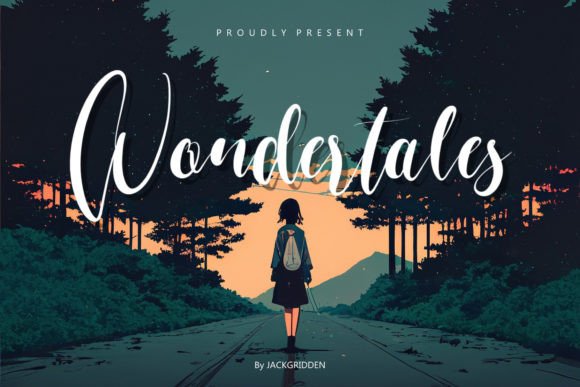
At its core, Wondertales is designed to capture the essence of fairy tales and magical adventures. Unlike standard serif or sans-serif typefaces that prioritize neutrality and clarity above all else, Wondertales leans heavily into character. The font features graceful flourishes that add an immediate touch of elegance, while its delicate strokes evoke a sense of wonder and imagination. When you look at the letterforms, you are not seeing rigid geometric shapes but rather organic movements that mimic the flow of a quill pen or the whimsical nature of hand-drawn illustrations.
The distinctiveness of Wondertales lies in its ability to balance playfulness with sophistication. Many script fonts struggle to find this middle ground, often veering too far into illegibility or appearing too childish. Wondertales attempts to avoid these pitfalls by maintaining a consistent baseline and legible structure even as it introduces decorative elements. The playful curves suggest movement and energy, making it particularly effective for titles, headings, and short phrases where visual impact is paramount. It is a font that does not merely display text; it performs a narrative role, inviting the reader to suspend disbelief and enter a story.
Navigating the Script Font Landscape: Context and Comparison
To understand the value proposition of Wondertales, it is helpful to view it within the context of other available options. The market for decorative scripts is crowded, ranging from formal calligraphy styles to casual handwriting fonts. When evaluating Wondertales against these alternatives, several key differentiators become apparent.
- Formal Calligraphy vs. Whimsical Script: Traditional calligraphy fonts often feature high contrast between thick and thin lines, mimicking the pressure of a broad-edged nib. While elegant, they can feel stiff or overly traditional for modern fantasy projects. Wondertales, conversely, uses a more uniform stroke weight with softer transitions, creating a lighter, more airy feel that aligns better with themes of magic and youth.
- Casual Handwriting vs. Stylized Narrative: Casual script fonts aim to replicate everyday writing. They are excellent for invitations and personal notes but may lack the "enchanted" quality required for book covers or thematic branding. Wondertales sits in a niche between casual and formal, offering a stylized appearance that feels intentional and crafted rather than spontaneous.
- Display Fonts vs. Body Text: Many decorative fonts are strictly display-only, meaning they cannot be used for long-form reading. While Wondertales is primarily intended for headlines and accents, its design allows for slightly longer usage than many competitors, provided the background remains uncluttered.
This comparison highlights that Wondertales is not a universal solution. It occupies a specific space designed for projects requiring a strong narrative voice. If a project requires a font that looks like a printed newspaper or a modern tech manual, Wondertales would be an inappropriate choice. However, for content seeking to evoke a specific mood, it offers a level of specificity that generic scripts cannot match.
Evaluating Strengths and Tradeoffs
No typographic tool is without its limitations, and a thorough evaluation of Wondertales requires looking beyond its visual appeal to consider its functional performance. Understanding these tradeoffs is essential for making an informed decision.
The Strengths of Wondertales
The primary strength of this font is its atmospheric consistency. Whether used on a wedding invitation, a children's storybook cover, or a boutique product label, Wondertales maintains a cohesive identity. The graceful flourishes are well-integrated into the letterforms, meaning they enhance the design without overwhelming the text. This makes it highly effective for branding campaigns where a specific "world" needs to be established quickly. Furthermore, the font's legibility is surprisingly robust for a script of this complexity, allowing it to function effectively at larger sizes without losing its charm.
The Tradeoffs and Limitations
The most significant limitation of Wondertales, shared by almost all decorative scripts, is its unsuitability for dense body text. The intricate details and varying stroke widths can cause eye fatigue when reading long paragraphs. Additionally, because the font relies heavily on style, it may clash with very modern, minimalist design languages. If a project demands a stark, industrial, or hyper-clean aesthetic, the ornate nature of Wondertales will feel out of place. There is also the consideration of file size and rendering; complex vector paths in decorative fonts can sometimes result in larger file sizes, which is a factor to consider for web performance optimization.
Determining the Best-Fit Scenarios
Deciding to use Wondertales should be driven by the specific goals of your project. Based on its characteristics, there are clear scenarios where this font shines, as well as situations where alternative approaches are necessary.
When Wondertales is the Right Choice
Imagine you are designing a set of invitations for a themed event, such as a medieval fair or a magical birthday party. In this context, Wondertales acts as a visual shorthand for the experience. It immediately signals to the guest that this is not a standard gathering but an event steeped in tradition and fantasy. Similarly, for authors publishing self-written fantasy novels, using Wondertales for the title page or chapter headers can significantly enhance the immersion of the book. It pairs exceptionally well with imagery featuring forests, castles, dragons, or fairies, reinforcing the thematic elements of the artwork.
Another strong use case is in editorial design for lifestyle magazines focusing on arts, crafts, or storytelling. Here, Wondertales can serve as a pull-quote or a section header, breaking up the monotony of standard text while adding a layer of personality that reflects the content's creativity.
When to Choose Another Option
Conversely, if you are creating a user interface for a mobile application, Wondertales is likely a poor choice. UI design prioritizes speed of recognition and clarity above all else. The decorative elements of Wondertales could slow down the user's ability to scan buttons or menus. Similarly, for legal documents, financial reports, or educational materials where neutrality and authority are required, the whimsical nature of this font undermines the seriousness of the content. In these cases, a clean sans-serif or a classic serif font would provide the necessary professional distance.
Practical Implementation Strategies
For those who decide that Wondertales aligns with their vision, successful implementation requires careful attention to pairing and spacing. Because the font is visually busy, it benefits greatly from generous negative space. Crowding the letters or placing them over complex backgrounds can render the text unreadable. A common strategy is to pair Wondertales with a simple, understated sans-serif font for any supporting text. This creates a hierarchy where the script captures attention, and the secondary font ensures clarity.
Color selection also plays a crucial role. While black text on white paper is always safe, Wondertales often looks more enchanting when paired with soft pastels, deep jewel tones, or metallic finishes in print. The delicate strokes catch light differently depending on the color palette, so testing the font in various contexts is vital before finalizing a design.
Making an Informed Decision
Selecting a typeface is a nuanced process that involves balancing artistic intent with functional requirements. Wondertales offers a compelling solution for creators looking to infuse their work with a sense of magic and narrative depth. Its combination of delicate strokes, playful curves, and graceful flourishes makes it a standout option for projects that need to evoke wonder. However, it is not a one-size-fits-all solution. By understanding its strengths, acknowledging its limitations, and comparing it thoughtfully against other categories of fonts, designers can ensure they are using Wondertales only where it truly adds value.
Ultimately, the decision comes down to the story you want to tell. If that story is one of adventure, elegance, and imagination, Wondertales provides the perfect vessel. If the story requires precision, neutrality, or speed, other tools in the typographic toolbox will serve you better. With this balanced perspective, you are now equipped to evaluate Wondertales not just as a pretty font, but as a strategic design asset.